
By Khepri, Inc. · New York, NY
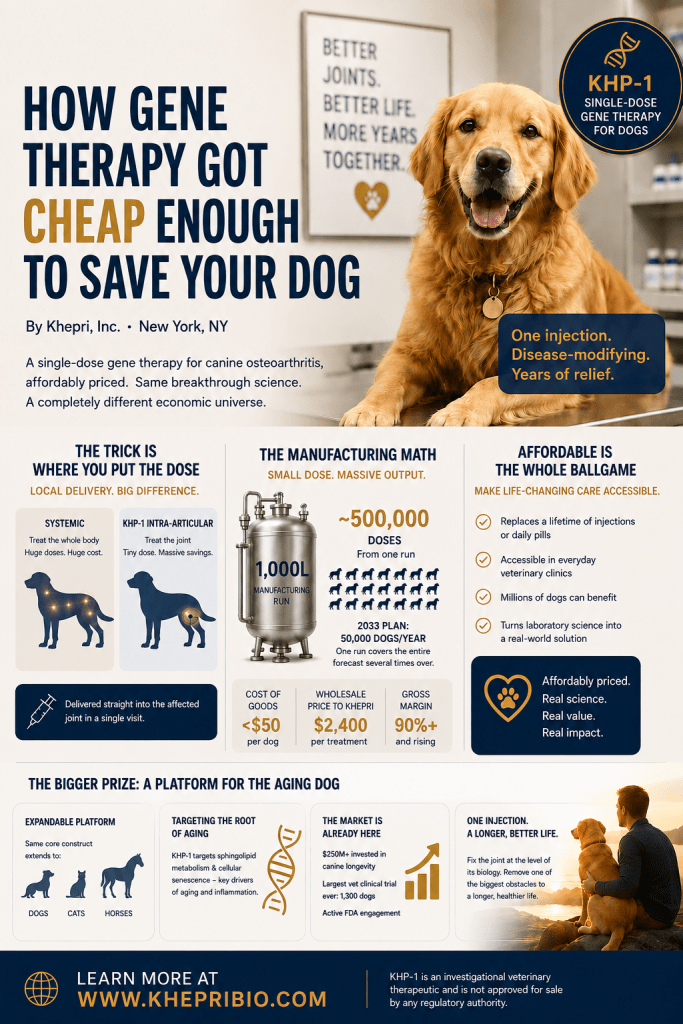
Say the words “gene therapy” and most people picture a million-dollar price tag. In human medicine, that reputation is earned — some approved gene therapies list well into seven figures. So when we tell people that Khepri‘s single-dose gene therapy for canine osteoarthritis is affordably priced to treat household pets, the reaction is almost always the same: how is that even possible?
The answer is the most important — and most overlooked — part of this whole story. The economics that make human gene therapy astronomically expensive simply do not apply to what we’re doing. And understanding why is the key to seeing both the medical breakthrough and the business underneath it.
The trick is where you put the dose
Most human gene therapies are systemic. To treat a disease throughout the body, you have to flood the entire bloodstream with viral vector — enormous doses, manufactured under extraordinary conditions, at staggering cost. The dose is the expense.
Khepri’s KHP-1 does the opposite. It is delivered intra-articularly — straight into the affected joint — in a single visit. Because the therapy only needs to work locally, in one enclosed space, it needs only a tiny fraction of a systemic dose. Same underlying AAV gene-therapy technology; a completely different economic universe. Local delivery keeps the dose small, the safety burden low, and — this is the punchline — the cost per treatment radically lower than anything the phrase “gene therapy” would lead you to expect.
Run the manufacturing math
Here’s what happens when gene therapy requires only a small, locally delivered dose. A single 1,000-liter manufacturing run — a scale already demonstrated in the industry and one Khepri is working toward from its current bench-scale process — could yield approximately 500,000 doses of KHP-1.
Half a million doses. From a single run.
That scale fundamentally changes the economics. Spread the cost of manufacturing across 500,000 doses, and the estimated cost of goods falls below $50 per treated dog. Against a $2,400 wholesale price to Khepri, that translates into a gross margin of more than 90%. And as manufacturing becomes more efficient and production costs decline, Khepri has room to reduce pricing over time while preserving attractive margins.
The result is something rarely associated with advanced therapeutics: gene therapy economics approaching commodity-scale manufacturing.
Why “affordable” is the whole ballgame
Affordability isn’t a nice-to-have footnote here. It is the reason this therapy can actually reach the dogs who need it.
A treatment that costs $50,000 helps almost no one, no matter how brilliant the science. A treatment that is affordable — and replaces a lifetime of monthly injections or daily pills that would cost the owner more than that anyway — can reach millions of animals. The affordability is what converts a laboratory triumph into a public good. It’s what lets an everyday veterinary clinic, not just a specialty center, offer it. It’s what makes “disease-modifying gene therapy for your dog” a sentence a normal family can actually say yes to.
That is the difference between a science project and a therapy that changes a category.
The bigger prize: a platform for the aging dog
Now widen the lens, because this is where affordable AAV stops being about one disease.
The same core construct that treats osteoarthritis extends to cats and horses — a second and third market riding on the same manufacturing and regulatory package. And the underlying biology KHP-1 targets — sphingolipid metabolism and cellular senescence — sits at the root of a whole family of age-driven conditions. Senescence, the process by which cells stop dividing and start spewing inflammation, is one of the central mechanisms of aging itself.
That places Khepri directly inside the fastest-growing story in animal health: canine longevity. Investors have poured over $250 million into companies developing lifespan-extension drugs for dogs, and the largest veterinary clinical trial ever run — 1,300 dogs — was conducted to test exactly this idea, with active FDA engagement behind it. The world has decided our dogs deserve more healthy years.
But you cannot give a dog more good years while osteoarthritis quietly destroys his joints and his spirit from the inside. Fix the joint at the level of its biology — affordably, in a single dose, in any clinic — and you’re not just treating a disease. You’re removing one of the largest obstacles between an aging dog and a longer, better life. A single affordable injection, delivered by any vet, becomes the first real building block of canine healthspan.
That is what cheap, local, durable gene therapy makes possible. Not a million-dollar miracle for a lucky few — a four-thousand-dollar one, for millions of dogs, delivered by the vet down the street.
Khepri, Inc. is developing KHP-1, a single-dose gene therapy for canine osteoarthritis, on a platform built for the aging animal. Learn more at khepri.vet.
This article is for general informational purposes only and does not constitute an offer to sell, or a solicitation of an offer to buy, any security. KHP-1 is an investigational veterinary therapeutic and is not approved for sale by any regulatory authority. Pricing, cost-of-goods, manufacturing yield, and margin figures reflect management estimates and forward-looking projections that involve substantial risk and uncertainty; actual results may differ materially. Forward-looking platform and longevity applications are early-stage and not yet demonstrated. Prospective investors should review definitive offering materials and consult their own advisors.
 Khepri
Leave a comment