
By Khepri, Inc. · New York, NY
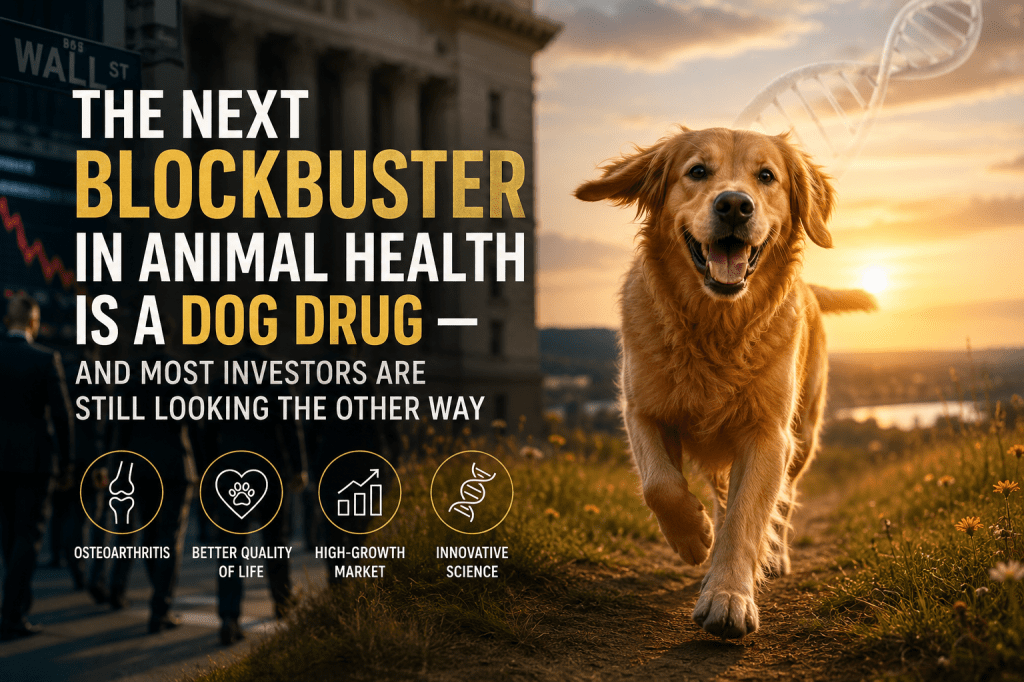
Here is a number that should stop you cold. A single monthly injection for canine osteoarthritis — a drug that blocks pain without touching the disease — reached a $460 million annualized revenue run-rate roughly one year after its U.S. launch. More than a million dogs have been treated with it. Nearly 25 million doses have shipped worldwide.
That is not a niche. That is a blockbuster franchise, built by Zoetis, in a category most generalist investors have never seriously looked at. And it was built on a product that, by design, never cures anything. It manages a symptom, forever, one paid injection at a time.
Now sit with the obvious question: what happens when someone shows up with a version that actually treats the disease — for a fraction of the lifetime cost, in a single dose?
That company is Khepri. And this is your early look.
The category is already proven — and already paying
The hardest thing in any market is convincing customers to pay for a new kind of product. In canine osteoarthritis, that education is already done, and someone else paid for it. Zoetis spent years and hundreds of millions of dollars training owners and veterinarians to accept — and pay for — an injectable OA biologic. The willingness to pay is established. The clinical behavior is established. The distribution rails are built.
Khepri doesn’t have to create the category. It has to win a slice of a category that already exists and is already spending. Consider the funnel:
- ~89 million pet dogs in the United States
- ~14 million with clinical osteoarthritis
- ~4 million already under active veterinary pain management — the immediately addressable pool
- 50,000 dogs in Khepri’s 2033 plan — roughly 1% of that pool
Read that last line again. The financial model does not require Khepri to win the market. It requires it to win one percent of the customers who are already paying for an inferior product. That is not a moonshot assumption. That is a rounding error against the incumbent’s own installed base.
The economics are almost unfair
Everyone else in this market sells a subscription. Khepri sells a cure attempt — and the unit economics are the part that makes investors lean forward.
KHP-1 is priced at roughly $4,000 to the end user, $2,400 wholesale to Khepri, against a cost of goods under $200 at scale — a gross margin north of 85%. And crucially, a dog owner already spends more than $4,000 over the lifetime of a monthly-injection or daily-NSAID regimen, spread across years of repeat visits. Khepri isn’t asking the market to spend more. It’s offering a better outcome for the dog, a lower lifetime cost for the owner, and a dramatically stronger margin for everyone in the distribution chain. When the better product is also the cheaper product over a lifetime, adoption is not a marketing problem. It’s gravity.
Why the smart money is already circling
If you think this is a fringe bet, look at who has been writing checks in companion-animal biologics over the last three years:
- Dechra acquired Invetx — a veterinary monoclonal antibody platform — for $520 million (2024)
- Boehringer Ingelheim acquired Saiba Animal Health — therapeutic vaccines for allergy, inflammation and pain — (2024)
- Zoetis acquired PetMedix — therapeutic antibodies for dogs and cats — for roughly $210 million (2023)
Every one of those was a platform with no approved product. The strategics — Zoetis, Boehringer, Dechra, Ceva — are actively hunting for exactly this asset class, and Ceva in particular has publicly leaned into AAV gene therapy. Khepri offers the same profile those buyers already paid up for, but with a completed 80-dog pilot, a settled regulatory path, and a one-and-done disease-modifying mechanism no acquirer currently owns. A crowded buyer’s table is the best exit insurance a Series A investor can have.
And the tailwind behind all of it: dogs are the new longevity frontier
The single hottest theme in animal health right now is canine healthspan — helping dogs live longer, better lives. Loyal has raised over $150 million to develop lifespan-extension drugs for senior dogs and just ran the largest clinical trial in the history of veterinary medicine (1,300 dogs). The FDA has built a supportive pathway and is actively engaging. Capital is flooding toward the idea that we can, and should, add healthy years to our dogs’ lives.
Osteoarthritis is the disease standing directly in the way of that vision. You cannot give a dog more good years while his joints quietly destroy themselves. KHP-1 sits squarely at the intersection of the two most fundable stories in the sector — disease-modifying biologics and canine longevity — and it is one of the only assets that credibly serves both.
The window is the point
Here is the uncomfortable truth about early-stage investing in a hot category: the return lives in the gap between “unproven” and “obvious.” Once KHP-1 has an approval and a strategic bidding war, the price reflects it. The investors who make the outsized returns are the ones who saw the 80 dogs, understood the margin structure, and recognized the buyer’s table before the rest of the market caught up.
Animal-health biologics is a market racing from roughly $25 billion today toward $50 billion-plus over the next decade, with biologics and monoclonal antibodies as the fastest-growing segment inside it. Blockbusters are being built in this space right now. The only question is who owns the next one.
Khepri is raising a $9.6M Series A to take KHP-1 through its pivotal trial to an approval package — fully funded, from today, to the finish line of the study. Family offices who love dogs and want to be part of the story, venture investors who see the margin structure, and strategics who recognize the asset: the table is being set now.
The dogs are ready. The market is proven. The buyers are waiting. The only thing missing is you.
Khepri, Inc. — one injection, a lifetime of mobility. See the full investor deck: khepri.vet.
This article is for informational purposes only and does not constitute an offer to sell, or a solicitation of an offer to buy, any security. Any offering will be made only to qualified investors pursuant to definitive offering documents and applicable securities laws. Forward-looking statements — including projections of market size, revenue, margins, adoption, and regulatory outcomes — involve significant risks and uncertainties; actual results may differ materially and are not guaranteed. KHP-1 is an investigational product not approved by any regulatory authority. Market and third-party figures are drawn from published sources and management estimates. Investing in early-stage private companies involves a high degree of risk, including the total loss of capital. Prospective investors should conduct their own due diligence and consult their own financial, legal and tax advisors.


Leave a comment